



Blog
Ventilator Preventive Maintenance: Parts and Consumables a BMET Should Stock

A ventilator’s preventive maintenance program lives or dies on parts availability. Half of a PM’s scheduled tasks — replacing flow sensors, oxygen sensor cells, breathing filters, circuits, and worn pneumatic parts — cannot be completed on time if those parts are not on the shelf when the unit comes off service. This guide lays out what ventilator preventive maintenance actually consumes, which machine-side parts wear out and need replacement rather than adjustment, a PM checklist structure, and a stocking approach for hospital biomedical engineering teams and independent repair shops.
Consumable Policy and Preventive Maintenance Are Two Different Things
It helps to separate patient-side consumables from machine-side maintenance parts, because they follow different replacement logic. Infection-control guidance does not set a calendar for patient circuits: the CDC’s 2003 Guideline for Preventing Health-Care-Associated Pneumonia recommends not changing the breathing circuit on a usage schedule at all, but changing it when visibly soiled or mechanically malfunctioning (category IA), and changing an in-use HME only when it malfunctions or becomes visibly soiled (category II), while warning against routine HME changes more frequently than every 48 hours. That means circuit stock is consumed by patient events, not by the PM calendar.
Machine-side parts are the opposite: flow sensors, galvanic oxygen sensor cells, turbines, exhalation valves, and internal filters are replaced on service-interval or performance-trigger schedules defined in the manufacturer’s service manual. These are the parts that determine whether a PM actually completes, and they are the focus of a stocking plan.
Patient-Side Consumables to Keep in Stock
| Consumable | Function | Replacement trigger |
|---|---|---|
| Breathing circuits | Carry inspired/expired gas between ventilator and patient | Visibly soiled or mechanically malfunctioning (CDC category IA); single-patient use between changes |
| HMEs / HMEFs | Humidify and filter respired gas passively | Malfunction or visible soiling (CDC category II); not more often than every 48 hours routinely |
| Breathing system filters | Filtration performance of respired gases | Verified against a salt-particle test method such as ISO 23328-1:2003; replace per IFU or when soiled |
| Water traps and condensate management | Collect circuit condensate away from the patient | Condensate drained and discarded periodically (CDC, category IB); traps replaced when soiled or damaged |
| Cuff pressure accessories | Manometer for artificial airway cuff pressure checks | Calibrated instrument, not a consumable; AARC guidance recommends cuff pressure assessment with a manometer |
Two details from the same CDC guideline are easy to miss. Internal ventilator machinery should not be routinely sterilized or disinfected — internal work during PM is about wear parts and verification, not fogging the box with disinfectant. And humidifier fluid policy (sterile water for bubbling humidifiers) sits with respiratory therapy, so BMET stocking lists should not silently absorb it.
Circuits and filters are also the consumables with the least forgiving stock-out consequence: when a circuit fails mid-patient-use, the replacement has to be in the storeroom, not on a purchase order. The CDC’s change-on-condition guidance actually makes burn rate harder to predict than a calendar policy would, which is another reason to track consumption monthly rather than estimating from unit counts alone.
Machine-Side Parts That PM Replaces
These are the components most likely to appear on a ventilator PM work order, drawn from what independent shops and hospital teams order most often for intensive-care ventilators from Dräger, GE, Mindray, Maquet, and Vyaire fleets:
- Flow sensors and flow sensor accessories. Hot-wire and differential-pressure flow sensors drift or fail with contamination; many models use a replaceable sleeve or screen between sensor and circuit (for example, Dräger flow sensor sleeves and GE neonatal flow sensors). Stock one spare per ventilator model per unit in service.
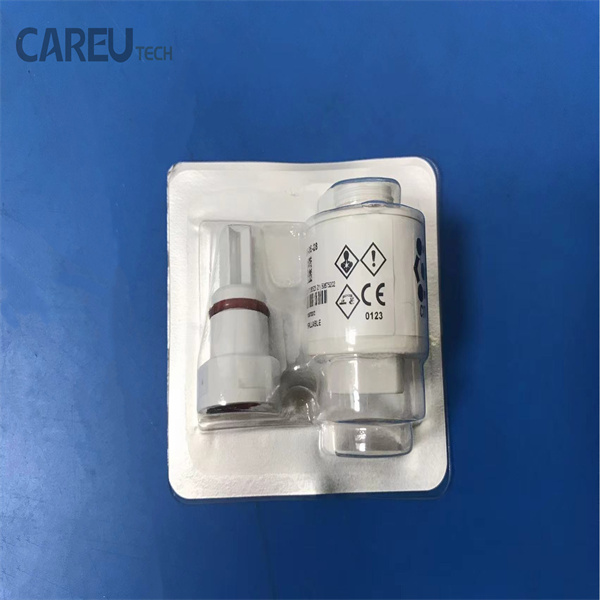
- Oxygen sensor cells. Galvanic fuel-cell O2 sensors deplete with exposure and time, and a spent cell produces O2-sensor alarms and calibration failure. CITY MOX-series cells are common replacements across ventilator and anesthesia machine platforms; replace per the manufacturer’s stated service life and on calibration failure.
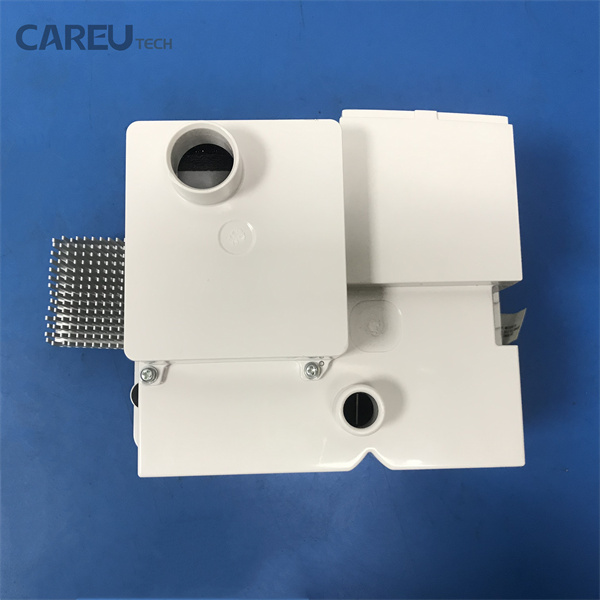
- Turbines and blower assemblies. Turbine-driven ventilators consume bearings and impellers over the equipment lifetime; Mindray SV-series turbine assemblies are a typical PM-replacement part at mid-life.
- Exhalation valves and diaphragms. Elastomer parts that set the expiratory pressure baseline; wear shows as inaccurate PEEP or expiratory flow readings.
- Interface and power boards. Gas module interface boards and power process boards (for example, Maquet Servo-i boards) move from “spare” to “PM stock” as fleets age and board exchange becomes the standard repair path.
Across all of these, source parts with model-level fit documentation. Our ventilator parts catalog lists flow sensors, O2 cells, turbine assemblies, and boards by the ventilator platform they fit, which removes the most common ordering error — a part that looks right but seats differently on the specific model. For oxygen cells in particular, also confirm the connector and output range: cell families differ in output characteristics across platforms, and a cell that fits physically but is specified for a different device will calibrate incorrectly or drift early.
Batteries deserve a line of their own. Internal and backup batteries are consumable-grade maintenance items with a service life shorter than most ventilator parts, and PM verification should include runtime under load rather than trusting the front-panel indication. Teams that treat batteries as a stocking item — with install dates recorded per unit — avoid the most common post-PM callback: a ventilator that passes its bench checks and then fails the first power interruption.
A PM Checklist Structure That Works
Manufacturers define the exact intervals and procedures in the service manual, and those documents govern. The table below is a work-order structure for organizing the parts pull before the PM, not a substitute for the manual.
| PM stage | Tasks | Parts pulled before starting |
|---|---|---|
| Pre-check | Visual inspection, alarms and self-test, review of use history and fault logs | Fault-log findings may add O2 cell, flow sensor, or board to the pull list |
| Patient-circuit side | Inspect/replace circuit-facing accessories per IFU; verify filter seating; humidifier check | Circuits, HME/Filters, water traps |
| Pneumatic path | Replace flow sensor sleeve or sensor per interval; check exhalation valve and diaphragm; leak test | Flow sensors/sleeves, exhalation valve/diaphragm kits |
| Gas measurement | O2 sensor calibration; replace cell on failure or service-life expiry | Oxygen sensor cell (MOX type or platform-specific) |
| Verification | Performance verification per service manual: delivered volume/pressure accuracy, alarm function, battery runtime under load | Test lung, manometer, calibrated flow analyzer if available |
| Documentation | Record parts used, verification results, next-interval date | PM record sheet; parts traceability labels |
How to Size the Stock
| Part | What drives consumption | Reorder trigger |
|---|---|---|
| Flow sensors and sleeves | Contamination, calibration drift, patient-circuit condensate | One on the shelf for every N ventilators of that model; reorder when the shelf spare is used |
| O2 sensor cells | Electrochemical depletion; consumption is calendar-driven, not usage-driven | Track install dates; reorder at two-thirds of stated service life |
| Circuits and HME/Filters | Patient events: soiling, malfunction, new admissions | Set by census and observed burn rate; review monthly |
| Turbine / blower assemblies | Hours of operation; mid-life wear | Keep one per fleet of the dominant model, or a vendor exchange arrangement |
| Boards (interface, power) | Age-related failures; exchange repairs | Order against failure history, not routine PM; one spare for fleets above roughly ten units of a model |
Verification Tools and Scheduling
The verification column in the checklist above assumes the bench has the right instruments: a calibrated flow analyzer for delivered volume and pressure accuracy, a manometer for circuit and cuff pressure checks, a test lung for load conditions, and a calibrated timer or load bank for battery runtime. Calibration status of the test equipment itself is part of the PM record — a verification performed with an out-of-calibration analyzer is not a verification. Shops without a full analyzer can still complete the manual’s simpler checks, but every skipped verification should be recorded as such, not silently dropped.
Scheduling is the other half of parts availability. When a fleet’s PM windows cluster in the same week, the parts pull for that week can exceed shelf stock even when the annual quantity is adequate. Staggering PM dates across the year — and reviewing the parts pull list a week ahead of each window — turns PM from an inventory spike into a steady, forecastable draw. For teams managing mixed fleets, aligning PM windows by platform rather than by unit makes the pull list easier to build and the reorder point easier to see.
Consumption patterns differ by fleet mix, so treat these triggers as a starting grid and adjust against your own PM records. Shops serving multiple facilities can pool the machine-side stock and carry a wider model range with the same shelf count.
Verification and Failure History
A PM is not finished when the parts are installed; it finishes with documented verification — delivered tidal volume and pressure accuracy against the service manual’s tolerances, alarm function, and battery behavior under load. The AARC’s clinical practice guideline on patient-ventilator assessment, published in Respiratory Care in 2024 (Goodfellow et al., 2024), is aimed at clinicians but reinforces the same principle from the other side of the bed: ventilator settings and monitoring must be assessed at regular intervals, which assumes the hardware behind those readings has been verified.
When investigating a recurring failure before deciding what to stock deeper, the FDA MAUDE database lets you search adverse-event reports by device and manufacturer — useful for spotting whether a failure mode on one ventilator model is systemic or isolated. Shops operating under a quality system aligned to ISO 13485:2016 should fold those findings into supplier evaluation and parts-selection records.
Teams that want to extend in-house ventilator service beyond first-line PM can review our monitor and peripheral parts catalog and our repair training courses, or send a model-specific parts request through the contact page.