



Blog
Rigid Endoscope Repair: Optical, Seal, and Mechanical Failure Modes

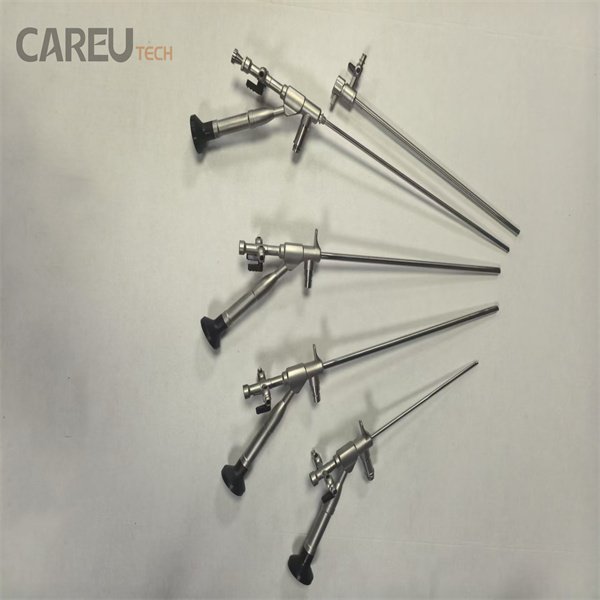
A rigid telescope rarely fails without warning. The surgeon reports a dark corner in the field, a fogged image that clears and returns, black dots drifting across the view, or an image that no longer rotates with the shaft. Each symptom points to a specific layer inside the instrument: the rod lens train, the fiber bundle, the outer shaft, or a seal. This article organizes rigid endoscope repair around those three failure families—optical, mechanical, and sealing—so that an independent repair organization (ISO) or hospital biomedical engineering team can diagnose the failure, order the right replacement parts, and verify the instrument before it goes back into service.

What is inside a rigid telescope
Most diagnostic and operative rigid telescopes (laparoscopes, arthroscopes, cystoscopes, hysteroscopes, ureteroscopes) share the same architecture. A train of rod lenses relays the image from the distal objective to the eyepiece. Around the lens train, thousands of glass fibers carry light from the proximal light post to the distal window. The optical train sits inside a stainless tube, sealed at both ends; the distal tip carries a sapphire or glass window, and the eyepiece carries an eyecup, diopter ring, and often a cork or rubber seal where the eyepiece assembly meets the shaft.
Understanding this layout matters for repair triage because the layers are stacked. A dent in the outer tube can crack the rod lens behind it. A failed distal seal lets steam and moisture condense on the objective, and the fog is often blamed on the autoclave rather than the instrument. Diagnosing which layer failed, before any part is ordered, is what separates a one-part repair from an unnecessary full rebuild.
Optical failure modes
Optical defects dominate repair intake. A research group at University Medical Center Utrecht that ran 1,599 objective measurements on clinical rigid endoscopes published the defects their repair firm reported on 68 endoscopes sent in during an eight-month window. Their counts are a useful benchmark for any service intake desk, because the same defect types appear in almost every repair queue:
| Defect reported by the repair firm | Count (68 endoscopes, 8 months) |
|---|---|
| Dust or particles visible on lens surfaces | 54 |
| Mechanical damage: dents, scratches, bent shaft, damaged tip | 46 |
| Broken rod lens(es) | 41 |
| Sapphire window at the tip needs replacement | 27 |
| Objective assembly needs replacement | 17 |
| Moisture condenses inside the endoscope | 11 |
| Eyepiece loose, torn, or adhesive damaged | 9 |
| Low fiber transmission | 5 |
| Other | 3 |
Broken rod lenses
A cracked or shattered rod lens usually follows a mechanical event: the scope struck a trocar edge, dropped onto a hard surface, or leaned against an instrument tray during sterilization. The symptom is typically a dark crescent, a shadow, or complete blackout in part of the field, and the image may stay sharp while a segment of the picture is missing. Bench diagnosis is straightforward: view the shaft against a bright light source and look for a visible fracture line inside the tube, then confirm with a through-the-scope test pattern. Replacement rod lenses must match the telescope’s diameter class and optical design; a lens from a different series will restore light but can shift the focal plane or the field of view.
Broken light fibers and black dots
Black dots or specks that stay fixed relative to the eyepiece indicate broken illumination fibers or debris on an internal lens surface. Fiber bundles break from bending stress at the light post and inside the shaft, from heat at the distal window, and from repeated steam cycles. The fiber bundle is the one component most repair shops avoid rebuilding: as the Utrecht group observed, “replacing the illumination fibres is relatively expensive and rarely opted for.” In practice, a scope with a badly degraded bundle is evaluated for full bundle replacement against the cost of a replacement telescope, using measured light transmission rather than a subjective “looks dim” judgment.
Distal window and objective damage
The sapphire window at the tip takes the most abuse: contact with power tools, shaver blades, and bone chips scratches or chips it, and a cracked window leaks steam into the objective assembly. Inspect the window under magnification, not with the naked eye; fine crazing is invisible at arm’s length but obvious under 10x or higher. A chipped window is also a patient-safety item—a damaged lens edge can shed glass particles into the operative field. Replacing a window requires re-sealing the distal assembly, so the work naturally includes the leak and fog checks described below.
Mechanical failure modes
Mechanical defects are the most visible: a dented or bent shaft that no longer fits the trocar, a stiff or drifting eyepiece diopter ring, a damaged light-post thread, or a stopcock that no longer seals on a cystoscope sheath. Two checks belong on every intake bench. First, roll the shaft on a flat surface and look for a visible gap under the tube; a bent shaft will also bind in a correct-diameter gauge ring. Second, rotate the scope while watching the field: the image should rotate smoothly with the shaft, and any wobble indicates a damaged eyepiece bearing or a bent internal sleeve.
The U.S. FDA’s MAUDE database collects adverse event reports that include rigid endoscopes losing focus mid-procedure, dark images, and scopes overheating at the distal tip—events that in several published reports trace back to mechanical damage around the distal end. Those reports are worth reviewing when building an intake checklist, because they show how small mechanical defects escalate into intraoperative failures.
Seal failure, moisture, and fogging
Moisture inside a rigid scope is one of the most under-reported defects because it hides until the scope is used. In the Utrecht series, the test bench detected moisture in 43 of 288 endoscopes, and on some occasions surgical departments kept using scopes with reported leaks up to ten more times before the instrument was pulled. The failure chain is predictable: a seal at the distal window, eyepiece, or light post degrades over steam cycles, steam enters during autoclaving, and the moisture condenses on the coldest internal surface—the objective—fogging the image.
Bench procedure for a fogging complaint:
- Cool the scope to room temperature, then look through it at a bright source; condensation appears as droplets or a haze on an internal surface.
- Localize the surface: fog that moves with rotation of the eyepiece sits at the eyepiece assembly; fog fixed in the distal third sits behind the objective window.
- Pressure-check or immersion-check the shaft where the manufacturer’s service documentation permits it, and inspect the eyepiece cork, light-post O-rings, and window bonding.
Reprocessing requirements add a documentation layer: ISO 17664-1 requires manufacturers to specify the cleaning, disinfection, and sterilization methods their devices can withstand, and repair work must restore the instrument to a state where it meets those original instructions. If a repaired scope fogs again within a few cycles, the seal was not the only defect—check the window seat and the shaft welds.
Measuring optics instead of guessing
Visual inspection underestimates optical degradation. Multicenter data from 95 optical test devices worldwide—roughly 500,000 measurements on clinical rigid endoscopes—show that usable lifespan varies from about 15 to 400 uses depending on type and handling, and that failures are often sudden, caused by a broken lens after mechanical or thermal shock. The same analysis found that repaired endoscopes have a median lifespan about 30% shorter and median light transmission about 11% lower than new endoscopes, which is why the authors recommend an entry measurement whenever a new or repaired scope arrives.
Facilities that measure light transmission (LT) and fiber transmission (FT) commonly reject endoscopes at 70% of the reference value for LT and 30% for FT, although practice varies with clinical tolerance and replacement cost. Even a modest setup—an illuminated test target, a camera, and a lux meter at the distal end—captures enough data to compare a scope against its own history and against a reference instrument of the same type. General performance requirements for rigid endoscopes, including optical and mechanical test methods, are set by ISO 8600-1, which is the reference standard to cite in purchase and repair specifications.
Repair or replace the instrument?
The repair-versus-replace decision is economic, not emotional. A useful sequence:
- Single-layer defect (window, rod lens, eyepiece, light-post fitting): repair. These are bounded jobs with predictable parts cost.
- Multiple layers (bent shaft plus broken lenses plus moisture): quote against replacement; the measurement data above shows rebuilt instruments rarely return to new-spec optics.
- Repeated repair history: a scope that cycles through the same defect every few months usually has an underlying handling or reprocessing problem; fix the process or retire the instrument.
Bench capacity matters too. A repair shop that already stocks rod lenses, sapphire windows, eyepiece assemblies, and light-post fittings for the scope models in its service area can complete single-layer repairs in-house and reserve rebuilds for batched outsourcing. The tools and fixtures needed for that kind of bench are covered in our endoscope repair bench tool checklist.
Acceptance checks before return to service
Whatever parts were replaced, the instrument should pass the same exit criteria before it is handed back. The table below is a practical acceptance sheet for a repaired rigid telescope.
| Check | Method | Pass criterion |
|---|---|---|
| Image integrity | Test target through the scope at working distance | No blackout sectors, no fixed shadows or dots |
| Field of view and rotation | Rotate scope while viewing target; compare against specification | Smooth rotation; field size and direction match type designation |
| Light transmission | Lux meter or reference source comparison at distal end | Within agreed threshold of same-type reference (e.g., ≥70% LT) |
| Moisture / fog | Temperature-stabilized scope, viewed against bright source | No internal condensation after thermal cycling |
| Shaft straightness | Roll on flat surface; gauge ring check | No visible gap; no binding in ring |
| Distal window | Magnified inspection | No chips, crazing, or coating damage |
| Light post and fittings | Thread check, cable mating check | Secure fit, no cross-threading, full cable insertion |
Ordering replacement parts: what suppliers need from you
Parts for rigid telescopes are model-specific. When requesting a quote for rod lenses, windows, eyepiece assemblies, or light-post fittings, include the scope manufacturer, the model or reference number printed on the light post or shaft, the diameter and working length, the viewing direction (0°, 12°, 30°, 70°), and, where relevant, the autoclave method in your facility—some bonding materials behave differently across steam and STERRAD cycles. A structured request shortens quoting time and reduces the risk of receiving a part that fits but does not match the optical series. Our rigid endoscope parts category lists components by brand and model, and the rigid endoscope overview page groups the product families most repair shops stock.
| RFQ field | Example | Why it matters |
|---|---|---|
| Manufacturer and model/ref no. | KARL STORZ 27002L | Optical series and fitting dimensions follow the reference number |
| Diameter × working length | 2.9 mm × 31 cm | Lens train and shaft parts are size-specific |
| Viewing direction | 30° | Objective assembly determines direction; mixing series shifts the angle |
| Failed component | Sapphire window, rod lens, eyepiece | Defines the parts kit and sealing work included |
| Sterilization method | Steam 134 °C / H2O2 plasma | Sealants and cements must match reprocessing chemistry |
Technicians who want to move from part swaps to full teardown and reassembly of rigid scopes—window replacement, lens train service, shaft straightening—can build that skill on a structured curriculum; our repair training courses cover flexible and rigid platforms on working instruments. For quotes on specific rigid scope components, or to confirm compatibility before ordering, contact us with the scope details above.