



Blog
Flexible Endoscope Repair Training — Olympus, Pentax and Fujifilm

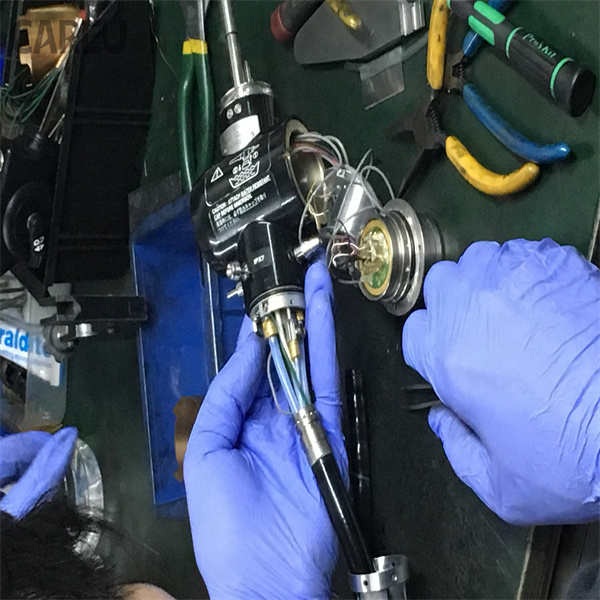

A flexible endoscope repair course is judged by one thing: whether a technician leaves able to open a scope, diagnose it, fit the right part, and prove the repair with recorded checks. That is how the flexible endoscope module of the CareUTech repair training programme is built. It runs at our Guangzhou facility or on-site at a hospital, is taught in small groups by engineers with years of field experience, and covers gastroscopes, colonoscopes, bronchoscopes and duodenoscopes on the Olympus, Pentax and Fujifilm platforms named in the module title. This article sets out what the module teaches, why the three brand platforms change the work, and the objective evidence a trainee is signed off against at the end.
What the flexible endoscope module covers
The module is organised around five service tasks: insertion tube replacement, bending section and angulation wire service, light guide bundle repair, leak testing, and final performance verification. Each task is practised on real devices rather than slides. Trainees disassemble, measure, rebuild, and then test the scope they have worked on, because the distance between reading a teardown sequence and executing one is exactly where repairs go wrong.
Because classes are small, the scope mix can follow the team. A hospital biomed group that mainly handles gastroscopes and colonoscopes will spend its bench time differently from an independent service organisation that also takes bronchoscopes and duodenoscopes, and the instructors adjust emphasis accordingly. The task list stays the same; the models it is practised on do not.
One boundary is stated plainly, because buyers ask about it often. The course produces a completion record and an instructor sign-off, not a personal certification. A personal credential such as the AAMI CBET is earned separately through examination, and a course certificate — from us or from any trainer — should never be presented as one. What the sign-off does provide is dated, task-level evidence that a named technician performed named procedures on named equipment. That is what an auditor or a customer’s quality department usually wants to see, and it is the evidence ISO 13485-style documentation expectations are built around.
Enrolment is deliberately simple. Tell us the device categories you want to train on and your preferred dates by email or WhatsApp, and we send back the course outline, duration, group size options and a quotation. There is no fixed public timetable or price list, because both depend on the scope mix and the group.
Why Olympus, Pentax and Fujifilm are taught as separate platforms
Three brand names cover most of the installed base of flexible video endoscopes, but a brand name is not a specification. Olympus, Pentax and Fujifilm scopes differ in control-section layout, valve and button interfaces, the imaging chain and its driver electronics, bending-section geometry, and the way the scope couples to a light source and processor. Within a single brand, successive model revisions can differ enough that a part quoted for one model will not fit another. Training therefore treats each platform — and within it each model family — as its own matching problem rather than teaching one generic teardown.
The published repair literature makes the same point with numbers. In an independent analysis of 341 repairs on Olympus flexible ureteroscopes published in Urology in 2007, every scope was inspected against a 16 to 32-point protocol defined per make and model, and the failure mix shifted measurably between two generations of the same brand: deflection-apparatus repairs fell from 20% on the URF-P2 to 7% on the URF-P3 (P<0.001), while the distal tip — the bending rubber in particular — remained the most common repair site at 30% of all repairs. If two generations of one Olympus scope family behave that differently, a course that teaches “the Olympus scope” instead of the model on the bench is teaching the wrong thing.
| Platform | Example model designations in the CareUTech parts catalogue | Replacement part families trainees work with | Matching rule taught on the bench |
|---|---|---|---|
| Olympus | GIF-Q260, GIF-H190, CF-HQ290L | Coil pipe assemblies, insertion tubes, CCD driver boards, button switches, light guide lenses | Quote against the full model designation, not the brand family |
| Pentax | EG-2990i, EC-3890Li, EG-2790I | CCD driver boards, bending sections, angulation wire sets | Board-level parts are not interchangeable across platforms |
| Fujifilm | EG-760Z | Angulation control hardware, bending sections | Confirm connector and coupling interfaces against the exact model |
The model designations above are examples drawn from the published parts catalogue to illustrate the matching discipline; they are not a compatibility list, and scope families beyond those shown are covered in training on request.
Bench skills and the evidence a trainee is signed off against
Every module ends the same way: the rebuilt scope has to pass a documented check, and the trainee has to explain what the check proves. Leak testing is the clearest example. The pressurised immersion baseline used on repair benches — pressurisation at or above 20 kPa with the scope submerged for at least one minute at 10–40 °C — comes from the water-resistant-type requirements in ISO 8600-7:2012. Trainees pressurise the scope, immerse it, locate any bubble stream, trace it back to a seal or a damaged component, and record the result against the scope’s serial number.
| Course task | Bench skill practised | Objective evidence recorded at sign-off |
|---|---|---|
| Insertion tube replacement | Tube measurement, stripping and rebuild | Diameter, length and bending-radius match confirmed against the model specification; leak test passed afterwards |
| Bending section and angulation wire service | Wire routing, tension setting, coil pipe replacement | Deflection range measured and recorded in both planes, with smooth travel and no slack |
| Light guide bundle repair | Bundle inspection and light-loss assessment | Light throughput and fibre condition documented before and after the work |
| Leak testing | Pressurised immersion and bubble location | Test pressure, duration and temperature recorded with a pass/fail outcome |
| Final performance verification | Full functional check of image, channels, valves and angulation | Written verification sheet, including internal inspection with a borescope where available |
These recorded checks are the acceptance criteria for the repair, and they double as the documentation a customer or auditor asks for afterwards. They are also the reason the course spends as much time on measurement and records as on hand skills: a repair that cannot demonstrate its own acceptance evidence is only half done.
The value of building training around inspection and records is visible in published data. At a large academic medical centre that performed a borescope inspection of every endoscope after manual cleaning, technicians completed roughly 109,000 inspections over three years; over the study period the proportion of repairs classified as major fell from 12.1% to 3.2%, mean cost per repair fell from $4,426 to $2,337 (P<0.001), turnaround shortened from 24.1 to 15.5 days, and uses between repairs rose from 52.1 to 87.2 in the study published in Biomedical Instrumentation & Technology in 2024. The same paper notes that guidelines recommend using borescopes during training and competency testing, and that the centre required technicians to hold board certification within two years of employment. Those figures belong to one centre’s programme, not to any training provider — but they show why structured inspection and recorded competency checks sit at the centre of a curriculum rather than at the end of it.
The framework around the bench skills is drawn from the same standards a repair operation is audited against. ANSI/AAMI ST91:2021 covers point-of-use treatment, leak testing where indicated, cleaning, high-level disinfection or sterilisation, storage and quality control for flexible endoscopes — the full loop a reprocessing-aware technician has to understand even when the repair bench is only responsible for part of it. ISO 13485:2016, whose scope explicitly includes servicing, requires organisations to determine and provide training, evaluate its effectiveness, and keep the records. In practice, that means a course should end with records you can file, not just a good week in the workshop.
Turning the course into a working capability
Training decays quickly without three things back at the shop: something to practise on, the right parts, and the right tools. The course is designed to connect to all three. On parts, trainees spend time with replacement components matched the way they will match them in production work — by full model designation — using components from the flexible endoscope repair parts catalogue, which can be browsed by brand through the shop-by-brand index. On tools, the tool families used during the course are the same families a working bench stocks: channel tools, dilators, rubber-sleeve tools, CCD disassembly tools, and the fixtures and test equipment for leak testing and deflection measurement.
Teams that want to keep the skill alive after the course should plan for practice material: one or two retired scopes for the bench, seeded faults to practise diagnosis, and a small stocked inventory of the parts that fail most often on the models they service. How to size that inventory is best settled during the course, while the instructor still knows exactly which tasks the team found hard.
Questions to settle before you enrol
The enrolment enquiry is also the right place to settle the questions that determine whether training transfers to daily work. The checklist below is what we suggest sending with your enquiry, whatever trainer you use.
| Question | Why it matters | What to ask for in writing |
|---|---|---|
| Which scope models will be on the bench? | Bench skills are model-specific; a course on scopes you never service transfers poorly | The model list for the training units |
| How much of the course is hands-on? | Lecture-heavy courses rarely build teardown competence | The course outline showing bench time per task |
| How is competence assessed? | Attendance is not competence | The sign-off sheet or test record a trainee receives |
| What does the certificate state? | Course completion is not a personal certification such as CBET | The exact wording of the completion record |
| What support follows the course? | Skills decay without parts, tools and practice material | The parts and tool list, and restock lead times |
To start, send the device categories you want to train on and your preferred dates to info@careutech.com or message the team on WhatsApp at +86 180 0229 5292; the reply includes the course outline, duration options, group size and a quotation. The current repair training course listings show what is available for enrolment, and the contact page routes general questions to the right desk.
A flexible endoscope repair course earns its fee when the technician who attended can, months later, take in a damaged scope, match the part correctly, rebuild it, and hand over a written verification that holds up in an audit. That is the standard the Olympus, Pentax and Fujifilm module is signed off against — and it is a reasonable standard to demand of any training you buy.