


Blog
On-Site vs Factory-Based Repair Training: How to Choose the Right Format

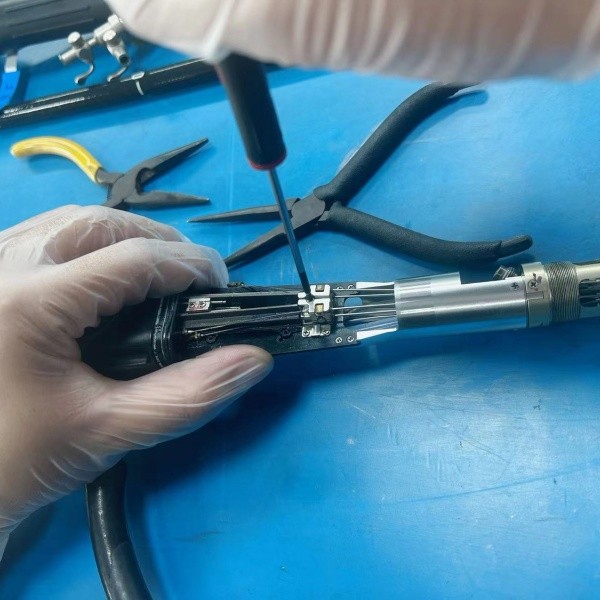
The choice between on-site and factory-based repair training is rarely about which format is better in the abstract. It is about what your team needs to practise on, how many people need to be away from the hospital, and what support continues after the instructor leaves. A course delivered at a hospital and a course delivered at a training facility can cover the same curriculum, but the logistics, the equipment available for hands-on work, and the cost structure differ. This guide sets out those differences as a decision framework for biomedical engineering (BMET) managers and independent service organizations (ISOs): what each format can realistically deliver, the questions to put in a request for quotation, and how to connect the training to competence records and audit readiness. It complements a buyer’s checklist for evaluating a repair training course and the follow-up work described in repair competency documentation.
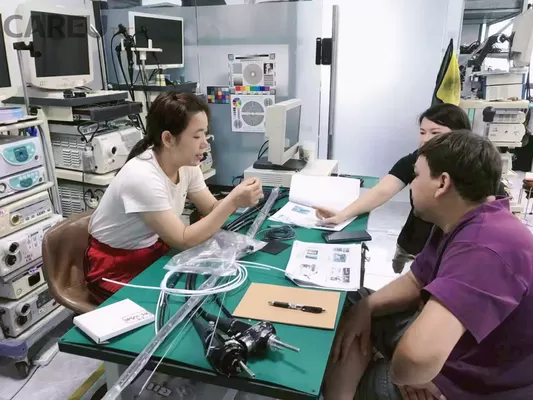
What the two formats actually change
CareUTech states on its repair training page that courses are held at its Guangzhou facility or on-site at the client’s hospital, that they combine theory with practice on real devices, and that they are taught in small groups by engineers with field experience. The page lists four training modules: flexible endoscope repair (Olympus, Pentax and Fujifilm; insertion tube replacement, bending section and angulation wire service, light guide bundle repair, leak testing and final verification); rigid endoscope repair (Richard Wolf, KARL STORZ, Stryker and Olympus; rod-lens optical systems, distal window replacement, sealing and leak testing); camera head repair (CCD/CMOS sensor handling, optical alignment, waterproofing and electrical testing across several brands); and ultrasound probe repair (cable and strain-relief replacement, acoustic lens repair, piezo element diagnostics and sensitivity testing). Enrolment is handled by email or messaging the team with the device categories and preferred dates; the course outline, duration, group size options, and a quotation are then provided.
That description fixes the honest boundary of the comparison. The curriculum, the hands-on principle, and the small-group format are the same in both locations. What changes is where the devices are, who travels, how many staff can be released at once, and what equipment is available to dismantle. Neither format should be described as inherently more rigorous; rigour comes from the course design, the instructor, and the assessment, not the postcode. Any claim about a fixed duration, a standard class size, a guaranteed pass rate, or a specific price would go beyond what the provider publishes and should be confirmed in writing during the quotation.
A decision matrix by constraint
The useful way to choose is to start from your binding constraint. If the constraint is that ten BMETs cannot all leave the hospital in the same week, on-site delivery is the practical answer. If the constraint is that your team needs to work on a wide range of scope and probe models that your hospital does not own, a training facility with a stock of devices and spare parts is the better fit. The table below maps common constraints to the format that usually handles them, and to the question that should be settled before booking.
| Your binding constraint | Format that usually fits | Why | Question to settle in the quotation |
|---|---|---|---|
| Many staff must be trained with minimal absence | On-site | The instructor travels; staff remain near their duties | How many attendees per session, and can sessions be staggered? |
| Team must practise on many device models and brands | Factory / facility | Training units, seeded faults and spare-part stock are on hand | Which exact models and revisions will be available? |
| Training must use your own in-service devices | On-site | Real devices from your own inventory are the teaching units | Can devices be released from clinical service for the session? |
| Repeatable bench setup and dedicated tools are needed | Factory / facility | Fixed benches, fixtures and test equipment are already installed | Which benches, leak testers and ESD provisions are provided? |
| Travel budget is limited but headcount is small | Factory / facility | Sending one or two people can cost less than hosting a course | What does the quotation include for travel and accommodation? |
| Training must cover a rare or single-model fault | Either, subject to device access | Depends on whether that model can be present at the session | Will a unit with that specific fault be available to practise on? |
Equipment, faults, and what “hands-on” has to mean
“Hands-on” is the phrase most open to misinterpretation. Watching an instructor disassemble a scope is not the same as doing it. Before booking, ask what proportion of the course each technician spends working on a device, whether faults are seeded into training units rather than demonstrated on a working one, how many devices are available per attendee, and which tasks each person must complete independently. The CareUTech page describes practice on real devices in small groups, but it does not publish a device-per-attendee ratio or a fixed practical-to-theory split; those are reasonable items to request in the outline.
Factory-based delivery has a structural advantage here: a training facility can keep dedicated units, faulty assemblies, and a stock of replacement parts on site without removing equipment from clinical service. On-site delivery has a different advantage: the team practises on the exact models it will maintain, in the environment where the work will happen, and can relate the training directly to its own inventory and service records. A sensible compromise for some teams is a short facility-based course for the underlying bench skills, followed by on-site sessions on their own device mix. Framing it that way also keeps the training bench separate from a production repair bench: a set of teaching units with seeded faults is a different asset from a working bench where the acceptance criteria are the finished scope passing its own leak test and inspection. Trainees should still be shown those acceptance checks, because the discipline they need back at the hospital is the same inspection standard applied to a repaired device.
Cost and logistics to budget honestly
Neither format is free of hidden cost, and the two cost structures are almost mirror images. On-site delivery moves one or a few instructors and possibly equipment to the hospital; the buyer’s costs concentrate in hosting, scheduling, and releasing devices from service. Factory-based delivery moves the technicians; the costs concentrate in travel, accommodation, and the opportunity cost of staff being away. Small teams often find factory delivery cheaper, while large teams often find on-site delivery cheaper, but the crossover depends on headcount, distance, and how long the course runs. Because the provider publishes a quotation rather than a fixed price, the only defensible comparison is a written quotation for the same curriculum, the same assessment, and the same group size in both formats.
Budget also for the items that make training stick afterwards: a basic set of bench tools and consumables, test equipment such as a leak tester, and the parts a newly trained technician will use in the first weeks. A course that ends with no way to practise the skill on the job decays quickly. Linking the course to a repair training course catalogue and to a plan for sourcing the relevant repair tools and replacement parts converts a one-off event into a capability. The published research on structured instrument repair training is instructive here: in the SIRT programme reported by Udeigwe-Okeke and colleagues in 2025 (Frontiers in Public Health), participants repaired 1,623 instruments with a 99.6% repair rate, and half of the participating hospitals went on to set up a repair workstation — the equipment and follow-up environment mattered as much as the instruction itself. That study concerns surgical instruments in a different setting, so it is evidence for the value of structured training plus a working bench, not a performance claim about any endoscope course.
Assessment, certificates, and audit readiness
How competence is tested should be agreed before the format is chosen, and it should not depend on the location. Ask whether each task has objective pass/fail criteria, whether the assessment is observed and signed off, and what record the attendee receives. Keep two distinct ideas separate in that conversation. A provider’s course certificate or completion record attests that a person attended and completed a specific training programme. It is not a professional certification. The AAMI Certified Biomedical Equipment Technician (CBET) credential, for example, is a separate, individual certification: its Full Status eligibility runs through three routes involving an associate degree or higher plus two years of BMET experience, a U.S. military biomedical equipment technology programme plus two years, or four years of full-time BMET work; Candidate Status gives applicants five years to meet the requirements; and the exam is a three-hour closed-book test of 165 multiple-choice questions across six content domains weighted approximately 30%, 30%, 17%, 10%, 7% and 6%, scored by a criterion-referenced modified Angoff method. No short repair course confers that credential.
On the standards side, AAMI’s EQ committee has published four U.S. national standards for HTM departments, listed on its standards overview: ANSI/AAMI EQ56:2024 for a medical equipment management program, EQ89:2015/(R)2023 on maintenance strategies, EQ93:2019/(R)2025 on vocabulary, and EQ110:2024 on healthcare technology management educational programs. The EQ56 news page notes that the standard applies to hospitals, manufacturers and independent service organizations, and addresses written repair procedures, documentation, inventory assessment and training records. ISO 13485:2016 (ISO standard page) requires competence to be established and the effectiveness of training to be evaluated. Together these point to the same conclusion: whichever format you choose, the output that matters to an auditor is a competence matrix, objective test data, and a work-record trail, not a photograph of the class.
| Item to agree before booking | On-site course | Factory-based course | Why it belongs in the quotation |
|---|---|---|---|
| Exact device models and revisions available | Your own in-service units | Facility training units and stock | Determines which tasks can actually be practised |
| Curriculum and module list | Same outline | Same outline | Keeps the two quotations comparable |
| Duration, group size, sessions | Confirmed in writing | Confirmed in writing | The provider does not publish fixed figures |
| Hands-on tasks per attendee | Agree device access | Agree device-per-attendee ratio | Separates practice from demonstration |
| Assessment and sign-off | Objective criteria | Objective criteria | Feeds the competence matrix and work records |
| Certificate wording | Course completion record | Course completion record | Distinguishes it from CBET or other individual certification |
| Post-course parts, tools, and support | Plan with your inventory | Plan with the supplier | Keeps the skill usable on the job |
A short RFQ checklist
Put the decision into a one-page request so both formats are quoted on identical terms: the device categories and models to cover; the number of attendees and whether sessions can be staggered; preferred dates and location; the curriculum and the specific tasks each person must complete; the practical-to-theory balance and device availability; the assessment method and pass/fail criteria; the exact wording of any certificate; the follow-up access to parts, tools and instructor support; and a full cost breakdown including travel, accommodation, and any equipment transport. CareUTech asks prospective attendees to send the device categories and preferred dates by email or messaging, and responds with the course outline, duration, group size options and a quotation, so that first message is the natural place to request both formats side by side. To start that conversation, use the contact page or the email and messaging details on the training page.
Common questions
Is factory-based training automatically more thorough? No. Thoroughness comes from the curriculum, the amount of independent hands-on work, and the assessment. A factory course may offer a wider range of devices and dedicated faulty units; an on-site course lets a team practise on the exact models it maintains. Judge both against the same criteria.
Does completing a repair course make a technician CBET-certified? No. A course completion record is evidence of training; CBET is a separate individual certification administered by AAMI with its own eligibility routes and a 165-question exam. Keep the two clearly separated in competence records and job descriptions.
Which format is cheaper? It depends on headcount, distance and duration. Because the provider quotes rather than publishes a price, request a written quotation for the same curriculum, assessment and group size in both formats and compare the total cost, including travel and staff absence.
In the end the format is a logistics decision in service of a documentation outcome. Choose the location that gives your technicians the most independent practice on the devices they will actually repair, then make sure the course ends with objective assessment, a competence record, and a supply plan for the parts and tools that keep the skill alive. That is what turns a training week into a capability an auditor can verify.