


Blog
How to Evaluate a Medical Equipment Repair Training Course: A Buyer’s Checklist

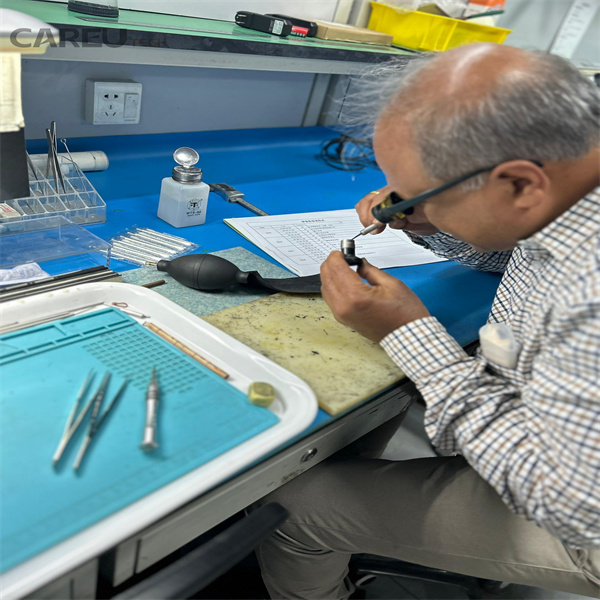
A repair training course is bought the way test equipment is bought: by specification, not by brochure. Two courses can carry the same title and leave a technician with completely different abilities, because the value sits in checkable details — which device families and bench tasks are covered, how much time is spent on real faulty units, how many trainees share each bench, whether the instructor still repairs devices for a living, how completion is assessed, and what support continues once the course ends. This checklist walks through each point with the specific questions worth asking before a deposit is paid.
What the course should actually cover
Start with the written outline. A credible provider states the device families, the brands handled, and the individual bench tasks per module. Vague titles such as “advanced endoscope repair” without a task list are a red flag, because two trainees can attend the same course and practise completely different skills. As a concrete reference point, the modules described on our repair training page name the scope families, the brands, and the tasks for each track, which is the level of detail a buyer should demand from any provider:
| Module | Device families and brands | Representative bench tasks | Detail to confirm before enrolling |
|---|---|---|---|
| Flexible endoscope repair | Gastroscopes, colonoscopes, bronchoscopes, duodenoscopes (Olympus, Pentax, Fujifilm) | Insertion tube replacement; bending section and angulation wire service; light guide bundle repair; leak testing; final performance verification | Which scope models are on the bench; whether trainees practise on scopes with seeded faults |
| Rigid endoscope repair | Laparoscopes, ENT telescopes, nephroscopes, arthroscopes, cystoscopes (Richard Wolf, KARL STORZ, Stryker, Olympus) | Rod-lens optical assessment; distal window replacement; sealing and leak testing | Measurement method and acceptance limits used for optical results |
| Camera head repair | Heads for KARL STORZ, Olympus, Stryker, Richard Wolf, Smith+Nephew, CONMED/Linvatec, Fujifilm systems | Disassembly and reassembly; CCD/CMOS sensor handling; optical alignment; waterproofing; electrical testing | ESD-controlled bench setup and the electrical test equipment used |
| Ultrasound probe repair | Linear, convex and phased-array probes (GE, Philips, Toshiba, Siemens, Samsung, Mindray, Esaote, Alpinion) | Cable and strain-relief replacement; acoustic lens repair; piezo element diagnostics; sensitivity testing | Probe test fixture and the sensitivity comparison method |
If the equipment your team actually services does not appear in the outline, ask whether it can be added before you commit. A course built around one manufacturer’s scopes will not, by itself, prepare a bench technician for a mixed fleet. For flexible scopes specifically, make sure the leak testing and final performance verification tasks taught on the bench are consistent with the processing expectations in ANSI/AAMI ST91:2021, since a repaired scope re-enters the reprocessing workflow the same day it leaves your bench.
Hands-on time, class size, and real faulty devices
The single best predictor of a course’s value is the ratio of bench time to lecture time, and whether the hands-on work happens on real faulty devices rather than pristine demonstration units. The published evidence on repair training gives a useful benchmark. A 2025 evaluation of Nigeria’s Surgical Instruments Repair Technicians (SIRT) programme by Udeigwe-Okeke and colleagues in Frontiers in Public Health trained 36 hospital staff in two phases: a two-week online theory module that participants had to pass with at least 80% before advancing, followed by two weeks of supervised hands-on work in which participants were encouraged to bring faulty instruments from their own hospitals. Every participating hospital also received a complete instrument repair kit so the work could continue on site. Across the programme, participants evaluated 1,623 instruments with a 99.6% successful repair rate, and institutional workbenches were established in 50% of the hospitals.
Two lessons transfer directly to endoscope, camera, and probe training. First, assessment works when it is built into the structure — a fixed pass mark on theory, observed bench tasks, and outcome measures on real repairs — rather than bolted on as attendance. Second, the second phase of the same programme compressed the hands-on component to one week without compromising the skills learnt, because the trainees practised on devices they actually had to fix. Ask any provider the same three questions: what fraction of contact hours are at the bench, how many trainees share one workstation and one instructor, and whether trainees may bring their own faulty devices.
Instructors with repair bench experience
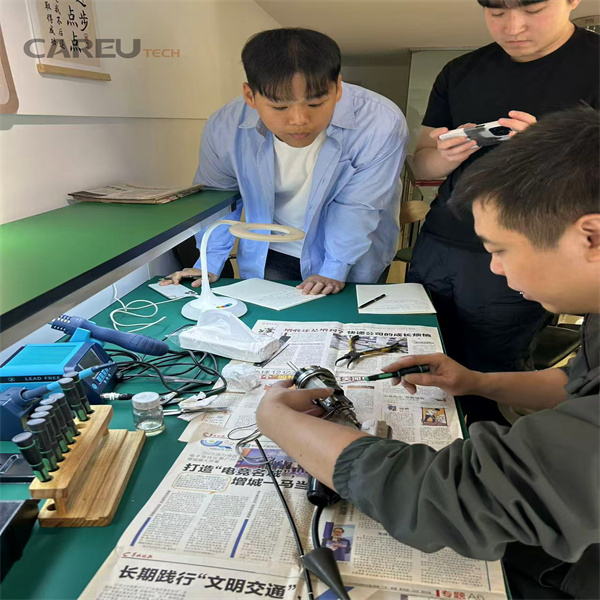
Ask who teaches, and what that person repairs when they are not teaching. An instructor who spends most of the year at a production repair bench will teach the shortcuts, the failure patterns, and the acceptance checks that a full-time lecturer cannot. Our own courses are taught in small groups by engineers with years of field experience, either at our Guangzhou facility or on-site at the client’s hospital, and trainees work on real devices rather than slides — a format we consider the minimum standard when comparing providers. The class-size question matters as much as the instructor question: with eight trainees and one bench, the arithmetic of hands-on time never works out.
How completion should be assessed
Certificates record attendance; assessments record competence. This is not our preference but a quality-system requirement: ISO 13485:2016 applies to organizations involved in the servicing of medical devices and requires them, in clause 6.2, to evaluate the effectiveness of the training and other actions taken and to retain records of education, training, skills, and experience. Before enrolling, ask what a trainee must actually demonstrate to complete the course, and what documentation you will receive as evidence. In the SIRT evaluation, post-training surveys found 83.3% of participants felt more confident identifying faulty instruments and 95.8% reported adequate repair skills — useful perception data, but the programme’s stronger evidence was the objective outcome: 1,623 instruments evaluated with a 99.6% repair success rate. Self-reported confidence and demonstrated skill are different measurements, and a provider should offer both.
| Assessment method | What it measures | Evidence to take away | Limits |
|---|---|---|---|
| Written theory test with a fixed pass mark | Device anatomy, failure modes, safety and handling rules | Score against a stated threshold (the SIRT programme used 80%) | Does not prove manual skill |
| Observed practical tasks against a checklist | Disassembly discipline, part handling, reassembly quality | Per-task sign-off by the assessor | Only as good as the assessor’s rubric |
| Repair outcomes on real faulty devices | End-to-end competence from diagnosis to verification | Devices repaired and verification results | Requires seeded-fault or client-supplied devices |
| Post-course follow-up on your own records | Skill retention and first-month rework | Rework and return rates from your CMMS | Depends on your own documentation discipline |
Vendor training versus person-level certification
Keep two things separate that marketing material often blurs: a vendor’s course completion certificate and a professional certification of the individual. In the United States, the benchmark personal credential for hospital technicians is the Certified Biomedical Equipment Technician (CBET), administered by AAMI’s Certification Institute. According to AAMI’s CBET page, full-status candidates qualify through one of three pathways — an associate degree or higher plus two years of full-time BMET experience, a military biomedical equipment technology programme plus two years, or four years of full-time BMET experience — and applicants who do not yet meet those thresholds can test under candidate status with five years to qualify. The exam itself is a three-hour, closed-book test of 165 multiple-choice questions spanning six domains, weighted approximately as follows: healthcare technology and function 30%, healthcare technology problem solving 30%, healthcare information technology 17%, public safety in the healthcare facility 10%, anatomy and physiology 7%, and fundamentals of electricity and electronics 6%.
The practical point for a purchasing decision: completing any manufacturer’s or service company’s repair course does not itself confer CBET status, and no honest provider will claim otherwise. What a good hands-on course does is build the device-family skills that the certification framework presumes. At the organisational level, AAMI’s Medical Equipment Management Committee maintains a set of national standards relevant to training buyers — including ANSI/AAMI EQ110:2024 for healthcare technology management educational programs alongside EQ56:2024 on medical equipment management programs — which an institution can use to frame what a training programme should contain and how it fits the wider equipment management system.
Questions to ask before you enrol
| Question | A good answer sounds like | A red flag |
|---|---|---|
| Which device families, brands, and models are physically on the bench? | Named scopes, camera heads, and probes per module, with brands listed | “General endoscope repair” with no model list |
| What share of contact hours is hands-on? | Explicit bench hours per task or day | Duration quoted only as lecture days |
| How many trainees share one workstation and instructor? | A stated maximum per bench | No class-size answer, or “depends” |
| Can we bring our own faulty devices? | Yes, plus seeded-fault training units provided | Only pristine demonstration units |
| How is completion assessed? | Fixed theory pass mark plus observed tasks plus outcome criteria | “Everyone receives a certificate” |
| Which replacement parts and consumables does the bench use? | The same parts used in production repair, with part numbers shown | Proprietary kits that are not available afterwards |
| What support continues after the course? | Parts supply, tool restocking, and documentation templates | Nothing beyond the certificate |
| Is the course certificate a professional certification? | A clear statement that credentials such as CBET are separate and exam-based | “Our certificate is an internationally recognized certification” |
Most providers, including ours, answer a written enquiry with the course outline, duration, group-size options, and a quotation — our enrollment process asks for the device categories and preferred dates and replies with exactly that package. A provider who cannot answer the questions in the table in writing is telling you something before the course starts. Our repair training course listings show the course formats we currently publish.
Parts, tools, and support after the course
Roughly half of a course’s value is realised after the trainees go home, and it depends on whether the same supply chain that supported the bench is available to them. The SIRT programme deliberately issued repair kits to every hospital for precisely this reason — skills without tools decay quickly. Before enrolling, confirm that the provider can supply the replacement parts used during training, restock consumables and bench tools, and support the documentation templates the course introduced. Our repair tools category mirrors the tooling used on our training benches, and our guide to setting up an endoscope repair bench covers the test equipment and consumables a newly trained team needs to budget for.
If you are comparing providers and want to see the bench before committing, we welcome prospective trainees to contact us with the device categories they want to train on and the dates they have in mind.
Frequently asked questions
How long does a hands-on repair training course take?
It depends on the device family and the starting point of the trainees. The published SIRT programme used a two-week online theory module followed by two weeks of supervised hands-on work, and found the hands-on phase could later be compressed to one week for new trainees without compromising the skills learnt. Ask any provider for the duration per module rather than a single headline number, and weight the answer toward bench hours.
Do trainees need prior repair experience?
Entry-level courses can start from zero: the SIRT participants included operating room and central sterile supply nurses with no prior repair experience, and the programme still achieved its outcome measures. Advanced modules on camera heads or ultrasound probes, however, presume existing disassembly experience — confirm the prerequisites per module before booking.
Is a course certificate the same as a professional certification?
No. A course certificate records that a named person completed a named curriculum. A credential such as the CBET is granted only after the candidate meets eligibility thresholds and passes an independent, proctored examination administered by AAMI’s Certification Institute. The two complement each other, and a provider who implies otherwise should be treated with caution.