



Blog
Building an Endoscope Spare Parts Inventory by Failure Rate


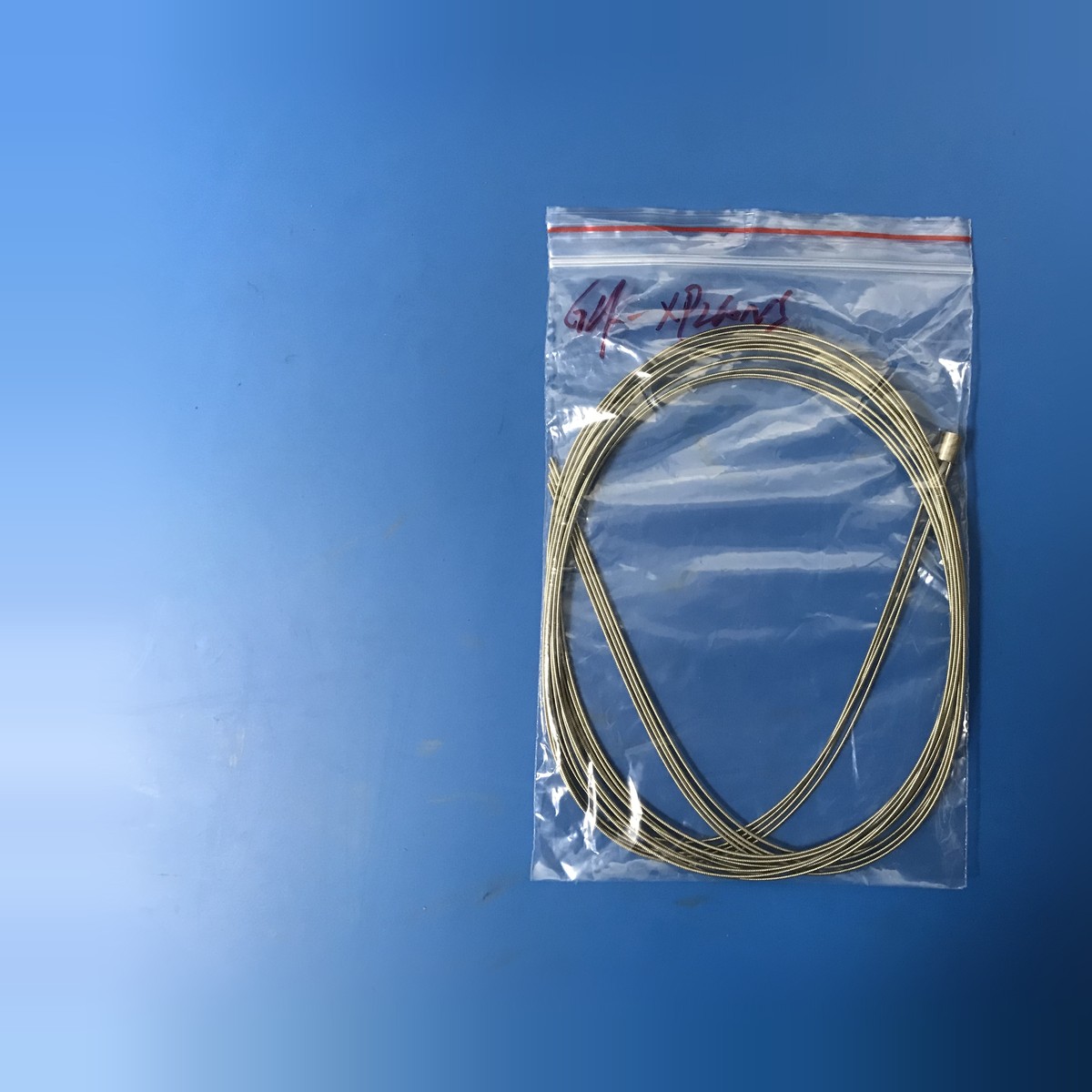
An endoscope spare parts inventory is not a catalogue with one of everything on the shelf. It is a decision about how many of each part to hold, driven by how often that part fails, what a failed scope costs while it waits, and how long a replacement takes to arrive. Stock too little and a $40 seal holds up a $6,000 repair; stock too much and capital sits in bending sections for models the fleet retired two years ago. This article sets out a defensible way to size that inventory from published failure data, and the incoming inspection and record discipline that keeps it honest. It is narrower than a sourcing guide: the question here is not whom to buy from, but what quantity of each part belongs on the shelf.
Start from failure frequency, not from a parts list
The most useful published starting point is a failure distribution, not a price list. In an independent analysis of 341 repairs on Olympus flexible ureteroscopes published in Urology in 2007, every scope was inspected against a 16 to 32-point protocol defined per make and model. The distal tip was the most common repair site at 30% of all repairs, and 87% of those distal-tip repairs involved the bending rubber; the deflection apparatus accounted for 14%. The mix also shifted between generations of the same product line: deflection-apparatus repairs fell from 20% on the URF-P2 to 7% on the URF-P3 (P<0.001). Two conclusions follow for stocking. Consumable sealing and bending-rubber parts dominate unit volume, and failure rates are model-specific enough that a fleet-level average can mislead.
Rigid scopes show the same shape of distribution with different parts. A 2013 multi-centre study of rigid endoscope defects (Wientjes and colleagues, PLOS ONE) reported, across 68 defective scopes, mirror contamination in 54, mechanical damage in 46, broken rod lenses in 41, damaged sapphire windows in 27, objective assembly faults in 17, and internal moisture in 11; in a wider sample, moisture was detected in 43 of 288 scopes. Those are rigid-endoscope findings and should not be applied to flexible scopes as rates. They do show why a stocking model built on one dominant failure mode is fragile: several part families each carry a meaningful share.
Repair volume per installed scope also matters, because it converts a failure rate into a monthly demand figure. A 2009 series of 478 ureteroscope procedures recorded seven repairs, a mean of 28.1 uses between repairs, and a calculated USD 120.63 per use (Semins and colleagues, Journal of Endourology). A 2024 paediatric series reported 4,280 reprocessing cycles with 29 failures, a 0.678% failure rate (Hu and colleagues, BMC Pediatrics). Neither number transfers directly to a different fleet. Both illustrate the arithmetic a stocking decision needs: scopes in service, procedures per scope, failures per procedure, and the parts each failure consumes.
| Part family | Published failure evidence | Suggested stocking tier | Reorder trigger |
|---|---|---|---|
| Bending rubber, O-rings, valve seals, silicone tubing | Distal tip 30% of 341 ureteroscope repairs, 87% of those bending rubber (Canales 2007) | Tier 1 — always on shelf, per scope model | Fixed minimum quantity; replenish on consumption, not on order |
| Coil pipe assemblies, angulation wire sets, bending sections | Deflection apparatus 14%; URF-P2 20% vs URF-P3 7% shows generation-level variation (Canales 2007) | Tier 2 — hold a small quantity per active model family | Reorder after each use; review the model list quarterly |
| Insertion tubes, biopsy channels, CCD driver boards | Lower unit frequency, higher part cost and longer sourcing lead time | Tier 3 — order against a confirmed job or a planned refurbishment | Confirmed work order, with a documented lead time |
| Rigid scope rod lenses, spacers, sapphire windows | Broken rod lenses 41 and damaged windows 27 across 68 defective scopes (Wientjes 2013) | Tier 2 for fleets with a rigid scope workload | Match to the specific telescope designation |
The tiers are a framework, not a claim about any particular fleet’s demand. A shop that services a single colonoscope model should hold far more Tier 1 stock relative to Tier 3 than a shop handling forty mixed models. The published distributions tell you which part families tend to dominate; your own work orders tell you the actual counts.
What inspection data does to the inventory
Inventory should be reviewed when inspection practice changes, because inspection changes the repair mix. A large academic medical centre that began borescope inspection of every endoscope after manual cleaning completed roughly 109,000 inspections over three years; over that period, major repairs fell from 12.1% to 3.2% of repairs, mean cost per repair fell from $4,426 to $2,337 (P<0.001), turnaround shortened from 24.1 to 15.5 days, and uses between repairs rose from 52.1 to 87.2 (Ofstead and colleagues, Biomedical Instrumentation & Technology, 2024). The same paper reports approximately 881 repairs over the period and notes that guidelines recommend borescopes during training and competency testing. Those figures belong to one centre’s programme, not to a parts supplier. Their relevance here is structural: finding damage earlier shifts work toward minor, high-frequency parts, which is exactly the Tier 1 stock a shop must have on hand to benefit from early detection.
Conversely, a fleet that replaces whole scopes on a fixed schedule suppresses its own spare-part demand. A 2025 analysis of more than 500,000 measurements from 95 optical test systems worldwide found time to failure varying from 40 to 400 uses, and that repaired endoscopes do not always return to the quality of a new one — up to 15% lower lens transmission and 20% lower illumination-fibre transmission (Noordmans and colleagues, 2025). The wide spread is the point: a calendar-based replacement rule either over-orders or under-orders relative to measured condition. Stocking decisions should follow the same measured condition logic.
Incoming inspection: the part is not stock until it passes
A received part is a liability until it has been checked against the model it is intended for. The most common bench error is not a defective part but a correct part filed under the wrong model designation. Receiving inspection is where that is caught, and where the traceability chain starts. ISO 13485:2016, whose scope includes servicing, requires organisations to verify purchased product and maintain the records that identify it; the same logic appears in ANSI/AAMI EQ56:2024 for medical equipment management programmes, which addresses written procedures, inventory evaluation and inspection records, and CMMS documentation.
| Receiving check | Method | Record to keep | Reject or quarantine when |
|---|---|---|---|
| Model designation match | Compare the full designation on the part and package against the work order, not the brand family | Part number, model, supplier lot, receiver, date | Designation differs by revision or suffix |
| Dimensional and connector fit | Measure against the outgoing part or a known-good reference unit; check connector pin count and keying | Measured values and the reference used | Any dimension or interface outside the reference tolerance |
| Seal and packaging integrity | Confirm unopened, undamaged, clean packaging; check expiry-dated consumables | Lot number and expiry date | Damaged seal, expired adhesive or cement, no lot traceability |
| Functional acceptance before fitment | Where testable, bench-test the board, valve set or channel before opening the scope | Pass/fail result tied to the part ID | Fails the bench check |
| Post-repair leak acceptance | After fitment, pressurised immersion per the water-resistant-type baseline in ISO 8600-7:2012 (at or above 20 kPa, at least 1 minute, 10–40 °C) | Test pressure, duration, temperature, result, scope serial number | Any bubble stream not traced to a resolved seal |
One regulatory boundary is worth keeping in view when the parts are not original equipment. The FDA’s final guidance on Remanufacturing of Medical Devices (May 2024, docket FDA-2018-N-3741) distinguishes servicing and repair from remanufacturing, and its guiding principles state that a component, part or material whose dimensional or performance specifications deviate from the OEM specification may significantly change safety or performance, warranting engineering analysis, verification and validation testing, or a risk assessment. That is a documentation obligation on the repairer, and the receiving record is where the evidence for it is assembled. We covered the sourcing decision itself in more depth in OEM vs compatible endoscope repair parts.
Turning the framework into an order
Start with the models actually in the fleet, not the catalogue. Pull twelve months of work orders, group them by full model designation, count parts consumed per repair type, and mark which repairs were delayed waiting for a part. That last column is the one that justifies Tier 2 stock: a part that appears four times a year but adds ten days to each repair is a better stocking candidate than a part used weekly that arrives overnight. The general flexible endoscope repair parts sourcing guide covers how parts are specified by model; the shop-by-brand index is useful for checking that the designation on the bin matches the designation on the order.
| RFQ line | What to state | Why the supplier needs it |
|---|---|---|
| Full model designations | Every scope model the stock will cover, including revisions | Seal sets and board-level parts are not interchangeable across generations |
| Quantity by tier | Tier 1 minimum quantities, Tier 2 per-model counts, Tier 3 as-needed | Determines whether parts are held, kitted, or quoted per job |
| Lot traceability | Required lot number, part number and packaging standard | Receiving inspection cannot be documented without it |
| Lead time per family | Expected lead time for Tier 2 and Tier 3 items | Sets the reorder point, not just the order size |
| Acceptance basis | Dimensional reference, bench test, and post-fitment leak test | Defines what happens if a received part does not match |
Browse the flexible endoscope repair parts catalogue to build the model list, and use the repair training programme to make sure the team matching parts on the bench uses the same designation discipline as the person placing the order. Inventory accuracy is mostly a communication problem between those two roles. For a consolidated quotation against a specific fleet list, the contact page routes the enquiry to the parts desk.
Review the tiers quarterly against new work orders, and quarantine stock for models no longer in service rather than letting it drift into general bins. A spare parts inventory is a living reflection of the fleet and the inspection regime, not a one-time purchase. Sized from failure data, checked on receipt, and reconciled against actual consumption, it turns a shelf of parts into predictable turnaround.